
Imagine you’re 21 years old. You’ve landed your dream job at the most famous company in your field, and in only your second week, you are on the verge of a legendary success. The world is watching. Victory is seconds away. Then, in an instant, it’s all snatched away by a problem you can’t control. This isn’t a hypothetical; it’s exactly what happened to Charles Leclerc at the 2019 Bahrain Grand Prix.
For the iconic F1 Ferrari team, anything less than victory is considered a failure. As the most historic and pressure-filled name in motorsport, they arrived in the deserts of Bahrain desperately needing to prove their new car was a winner after a disappointing season start. The expectation from millions of fans, and from within the team itself, wasn’t just to compete; it was to dominate.
At the heart of this high-stakes drama were two drivers representing the team’s past and its future. On one side was Sebastian Vettel, the decorated four-time world champion hired to bring glory back to Ferrari. On the other was the man in the second car, Charles Leclerc, a brilliant young prodigy in only his second race for the team who was already challenging the established order.
What unfolded under the floodlights was therefore more than just a car race. It was a public stress test that exposed a deep crack in the team’s foundation, forcing a confrontation between a proven champion and a rising star. This was the moment the old order began to crumble, changing the sport forever.
The Red Rocket Ignites: How Leclerc Stunned the F1 World Before the Race Even Started
A Formula 1 weekend isn’t just about the Sunday race. The day before, during a high-pressure session called “qualifying,” drivers get one hour to prove who has the fastest car in a flat-out sprint. The prize for the quickest lap is pole position—the coveted first spot on the starting grid, which offers a clear track and a massive advantage. It’s the best seat in the house, and in Bahrain, the 21-year-old Charles Leclerc was about to claim it in spectacular fashion.
This wasn’t just any pole position. For a driver in only his second race with the legendary Italian team, beating a four-time world champion teammate was a seismic event. Leclerc’s performance under the desert floodlights was a raw display of talent, proving that Ferrari’s new red rocket, the SF90, was genuinely the car to beat. He had not only earned the top spot but had also fired a clear warning shot to the entire grid—and, more importantly, to the other side of his own garage.
Ferrari suddenly had a wonderful, yet terrifying, problem. Their young prodigy was outperforming their established champion before the first corner of the race had even been turned. The team had arrived in Bahrain expecting Sebastian Vettel to lead their championship assault. Instead, the spotlight was stolen by the new kid who was simply, undeniably faster. This set the stage for a fascinating internal battle: what happens when a team’s designated future arrives a little ahead of schedule?
A Tale of Two Teammates: What Happens When the ‘Future’ Is Faster Than the ‘Present’?
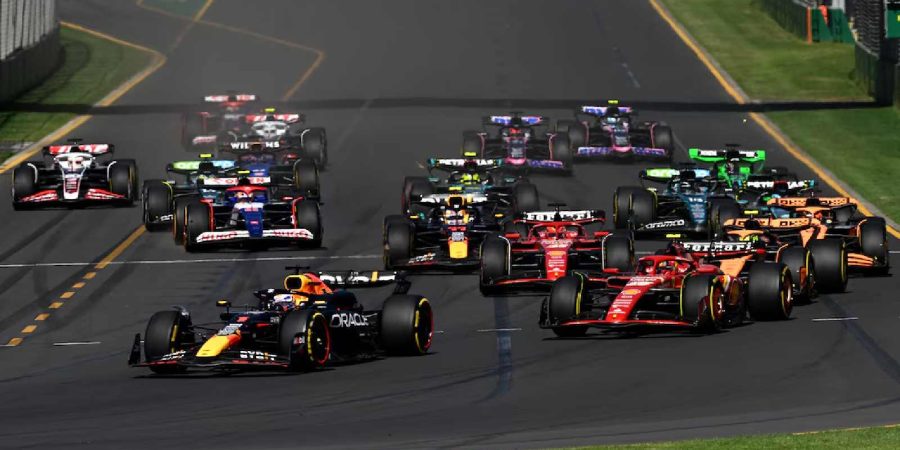
When the five red lights went out to start the race, Leclerc’s dream start from pole position evaporated. A poor getaway saw him swamped by the cars behind, and he fell to third place, watching his teammate Sebastian Vettel sweep past him. The advantage he had fought so hard for was gone in an instant. All his brilliant work from the day before was seemingly undone, and the established champion was back in front.
But the young driver’s initial fumble was temporary. Demonstrating incredible composure, Leclerc used the raw speed of his Ferrari to hunt down the leaders. Within a few laps, he was looming in Vettel’s mirrors, clearly the faster of the two. This created the exact scenario the team bosses dreaded: their young star was being held up by their veteran champion, and a difficult decision had to be made.
This is where Formula 1’s most controversial tactic comes into play: team orders. It’s an instruction from the pit wall telling one driver to let their teammate pass for the good of the team. While it sounds simple, it’s a politically explosive move, akin to a company publicly asking a senior executive to step aside for a junior colleague who is performing better on a critical project. It signals a shift in power.
After a tense few moments, the call came. Ferrari informed Vettel that Leclerc was faster, and the four-time champion moved aside. With that, Leclerc stormed back into the lead, proving his qualifying pace was no fluke. The team had been forced to publicly admit their prodigy was outperforming their champion. The internal hierarchy at Ferrari had just been flipped on its head, and the pressure on Vettel was now immense.
The Champion Cracks: How a Simple Mistake Revealed a Deeper Problem
Having already lost the lead to his own teammate, Sebastian Vettel’s night was about to take another disastrous turn. Now, his main rival, Lewis Hamilton, was hunting him down in the relentless silver Mercedes. For a four-time world champion who was supposed to be Ferrari’s undisputed leader, being overtaken by both his prodigy teammate and his arch-nemesis in the same race would be a crushing psychological blow. The pressure was visibly mounting.
As Hamilton prepared to pass, Vettel found himself wrestling with an invisible force known as “dirty air.” Think of it like the turbulent, choppy water behind a large boat. A Formula 1 car creates a similar wake in the air behind it. When a car follows too closely, it’s driving through this disturbed air, which prevents its own wings from working properly. The car loses grip and stability, feeling skittish and unpredictable, almost like trying to walk on ice.
Under the immense strain of holding off Hamilton while fighting the physics of his own car, the champion finally cracked. As the two went side-by-side down the straight, Vettel lost control. His Ferrari pirouetted in a cloud of tire smoke, the glowing hot brakes a beacon in the desert night. It was a shocking driver error, not a mechanical fault, and it broadcast his vulnerability to the world. With his race effectively ruined, all of Ferrari’s hopes now rested squarely on the young shoulders of Charles Leclerc.
“Something’s Wrong”: Decoding the Radio Call That Broke a Million Hearts
With his teammate’s challenge over and the track clear ahead, Charles Leclerc was writing his fairytale ending. A first win for Ferrari, redemption for the team, and the arrival of a new superstar. Just 10 laps from the finish line, victory seemed like a formality. Then, a chilling message crackled over the radio, laced with a stunned calmness that made it all the more terrifying: “There is something strange with the engine!”
His red rocket, dominant all night, was suddenly losing its punch. On the long straights where he had been untouchable, Leclerc was now painfully slow, his car’s speed dropping like a stone. It was the mechanical equivalent of a world-class sprinter pulling a hamstring just meters from the finish line; the will to win was there, but the power was simply gone. Leclerc was a sitting duck, his commanding lead evaporating with every passing second.
Soon, the inevitable happened. Lewis Hamilton’s silver Mercedes, which had been a distant spec in Leclerc’s mirrors, closed the gap with shocking speed. As he swept past the limping Ferrari to take the lead, Hamilton gave a sympathetic wave. It wasn’t a triumphant pass; it was a moment of sportsmanship, a champion acknowledging the cruel hand fate had dealt his young rival.
Just a few laps later, the second Mercedes of Valtteri Bottas also sailed past, demoting Leclerc from a certain victory to a potential third place. Through it all, Leclerc’s voice on the radio remained astonishingly composed. There was no screaming, no panic—just a driver calmly reporting the problem as his dreams dissolved in real-time, earning him immense respect from everyone watching.
The Ticking Time Bomb: What Actually Broke Inside Leclerc’s Ferrari?
So, what exactly went wrong inside the most advanced racing car on the planet? The devastating issue wasn’t a catastrophic explosion, but a failure of a single, crucial component. Think of the engine as having six chambers, or cylinders, that fire in perfect sequence to create immense power. In Leclerc’s car, one of these cylinders simply stopped working. It was like one rower in a six-person crew suddenly dropping their oar—the boat could still move, but its championship-winning speed was gone.
It’s easy to wonder how a team with Ferrari’s resources could suffer such a problem. The answer lies in the incredible complexity of modern F1 cars. They don’t have simple engines like the one in your road car; they have what’s called a Power Unit. This is a breathtakingly intricate hybrid system that blends a traditional engine with multiple electrical recovery systems. While this technology creates astonishing speed, it also introduces thousands of potential failure points where one tiny fault can cripple the entire machine.
This mechanical heartbreak made one thing crystal clear: the failure belonged to the car, not the driver. Leclerc had performed flawlessly, out-driving a four-time world champion teammate and controlling the race with the poise of a veteran. His dream was undone by a reliability flaw deep within Ferrari’s new engine. Yet, in a final, bizarre twist of fate, the race wasn’t quite over, and luck was about to intervene in the most unexpected way.
A Finish Born from Luck: How a Twist of Fate Saved Leclerc’s Race
Limping around the track, Charles Leclerc was a sitting duck. His wounded Ferrari was powerless as Lewis Hamilton’s Mercedes swept by to take the lead, followed shortly after by his teammate Valtteri Bottas. With Red Bull’s aggressive driver Max Verstappen rapidly closing in, it seemed certain that Leclerc wouldn’t just lose the win, but would be knocked off the podium entirely—a complete and utter heartbreak after a perfect weekend.
Just as Verstappen was about to pounce, a bizarre stroke of luck intervened. On another part of the circuit, two cars from the Renault team both stopped on track at the exact same moment. This created a dangerous situation, forcing race officials to deploy the Safety Car. Think of it as a referee hitting a giant pause button. A real car enters the track ahead of the leader, forcing every driver to slow down dramatically and hold their position. Crucially, overtaking is strictly forbidden.
This sudden truce was Leclerc’s salvation. The race finished under these slow, controlled conditions, with the cars parading across the line in a single file. Verstappen, stuck behind the crippled Ferrari, was unable to make the final pass. While the victory he so richly deserved had evaporated, this incredible twist of fate secured Charles Leclerc his first-ever podium finish in Formula 1. It was a bittersweet result born from both dominance and pure chance, setting the stage for a powerful show of sportsmanship.
A Rival’s Respect: Why Hamilton’s Reaction Meant More Than a Trophy
In victory, Lewis Hamilton could have simply celebrated his good fortune. Instead, before stepping onto the podium, his first act was to find and console a devastated Charles Leclerc. Pulling the young driver aside, the reigning world champion offered words of encouragement that echoed around the globe: “You drove fantastically all weekend,” Hamilton said. “You’ve got a long, long future ahead of you.”
This gesture was far more than just a polite consolation. In the cutthroat world of Formula 1, where psychological games are as vital as horsepower, this kind of public endorsement from the sport’s top predator is incredibly rare. It’s the equivalent of a legendary heavyweight boxer, after a grueling title fight, raising his opponent’s arm to the crowd. It was a clear, unambiguous anointment—the reigning king of the sport acknowledging that he had just met a genuine heir to his throne.
Ultimately, Hamilton’s reaction confirmed what millions of viewers had just witnessed. While a piece of his engine had failed, Leclerc’s talent had not. The trophy went to Mercedes, but the respect of the grid and its greatest champion went squarely to Ferrari’s young star. This powerful moment signaled a fundamental shift in the sport’s hierarchy. While Leclerc had lost the race, the respect he earned that day proved to be a far greater victory for his career.
The New Order: Why a Crushing Defeat Was Leclerc’s Greatest Victory
The image of a slowing red car at the 2019 Bahrain Grand Prix was far more than a sad moment in a race; it was a crucible that exposed the immense pressure, colliding ambitions, and shifting loyalties defining the night Ferrari cracked.
In that moment of mechanical betrayal, Charles Leclerc lost a trophy but won something far more valuable. His grace in defeat, combined with the raw talent he displayed all weekend, captured the hearts of millions and the deep respect of his rivals. He had lost the battle but undeniably secured his position as the future of motorsport’s most famous team.
This single event dictated the impact of Bahrain 2019 on the F1 season. It exposed a vulnerability in a four-time champion, Sebastian Vettel, and ignited the tense Leclerc vs Vettel team dynamics of 2019 that would captivate the sport. The old order was fractured, and the new one was announced not with a victory, but with a valiant, heartbreaking drive to third place.
The next time you watch a race and see a driver leading comfortably, remember that the story is never over until the final lap. Look beyond who crosses the line first and ask, “Who really won today?” This race was a powerful reminder that in Formula 1, the most powerful victories—the ones that define careers and change the course of history—are often disguised as failure.