
How fast is truly fast? A Boeing 747 jumbo jet lifts off the runway at around 180 miles per hour. Yet, in 2003, at a legendary Italian racetrack, Formula 1 cars were hitting speeds over 230 mph, lap after lap. It seems counterintuitive, but the fastest cars in F1 history aren’t the ones racing today; they belong to a special era that peaked for one unforgettable afternoon.
That afternoon was September 14, 2003, at the Monza circuit near Milan. Known as the “Temple of Speed” for its incredibly long, flat-out straightaways, Monza has always been the ultimate test of a car’s raw power. On this day, however, it became the stage for a spectacle of speed so extreme that it has never been repeated, resulting in the fastest Formula 1 race in history.
This wasn’t just a time trial; it was a breathtaking battle. In what became the ultimate slipstream shootout, the top five drivers fought relentlessly, finishing the race separated by just a handful of seconds. The 2003 Italian Grand Prix at Monza wasn’t decided by who had the fastest car, but by who could master the physics of high-speed pursuit.
So, how did this happen? It wasn’t just one thing, but a perfect storm of conditions that have since vanished from the sport. An investigation into that day reveals a unique combination: brutally powerful engines, a furious behind-the-scenes “tyre war,” and a simple law of physics that turned every car into a potential slingshot, creating a speed record that remains untouchable.
Why Italy’s Monza Circuit is F1’s “Temple of Speed”
Not all racetracks are created equal. While many circuits are tight, twisty affairs demanding incredible agility, the historic Autodromo Nazionale Monza in Italy is a different beast entirely. Nicknamed the “Temple of Speed,” its layout is a simple, brutal ribbon of asphalt dominated by incredibly long straights. For most of the lap, drivers have their foot pinned to the floor, asking everything of their engines. This unique design provides a pure and unforgiving test of raw power, making it the perfect guide to the Monza F1 circuit’s thrilling character.
This relentless focus on straight-line performance forces teams into a fascinating compromise. On a track like this—often called a “power circuit”—the brute force of the engine is far more valuable than a car’s ability to dance through tight corners. To gain an edge, teams prepare a special, low downforce aerodynamic setup just for this one race. It’s a high-stakes gamble where they willingly sacrifice grip in the corners for a few extra miles per hour on the straights.
Essentially, engineers make the cars as slippery as possible, reducing the angle on the wings so they slice through the air with minimal resistance. This makes the car incredibly fast in a straight line but also more nervous and difficult to control when turning. For the drivers, it’s like trying to tame a bucking horse at over 200 mph. This trade-off is precisely what makes Monza the ultimate top-speed battleground, creating the perfect conditions for drivers to use the air itself as a weapon.
The Invisible Force: How F1 Drivers Use “Slipstreaming” to Attack
Ever tried walking or cycling against a strong headwind? You can feel the air pushing back, forcing you to work harder. A Formula 1 car faces that same problem, but at over 200 mph, this invisible wall of air—known as air resistance, or drag—is a colossal force. The lead car uses a huge amount of engine power just to punch a hole through it, leaving a wake of disturbed, lower-pressure air directly behind.
For a driver following closely, this wake is a golden opportunity. By tucking their car into this “bubble” of calmer air, they experience far less drag. This is called slipstreaming. It’s like getting a free ride on an invisible wave of air, allowing the engine to work more easily and propel the car to a higher top speed than the one it’s following. Drivers often describe the effect as a “tow,” as if they’re being pulled forward by an unseen rope.
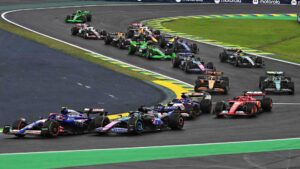
This phenomenon isn’t just a happy accident; it’s a fundamental tool for F1 overtaking. At a track like Monza, with its seemingly endless straights, a chasing driver will intentionally hunt down their rival to sit in their slipstream. As their speed builds, they can pull out at the last second and use that extra momentum to slingshot past before the next corner. It’s a high-speed game of chess, and when this tactic was paired with the uniquely powerful cars of the early 2000s, the results were simply breathtaking.
The Perfect Storm: What Made the 2003 F1 Cars Uniquely Fast
The mind-bending speeds seen at Monza weren’t just the result of slipstreaming. The 2003 season existed in a perfect technological sweet spot, a rare moment when several key factors aligned to create the fastest Formula 1 cars the world had ever seen. It was a perfect storm of power, grip, and design that hasn’t been replicated since.
This incredible speed was a product of three main ingredients:
- The Engines: This was the era of the mighty V10 engine. These 3.0-litre powerhouses produced over 900 horsepower and revved so high they created an iconic, piercing scream that fans still miss today. They delivered brutal, uncompromising power.
- The Tyre War: Two of the world’s biggest tyre companies, Michelin and Bridgestone, were locked in a fierce battle for supremacy. This “tyre war” forced them to develop incredibly soft, sticky tyres that provided immense grip, allowing drivers to carry more speed through corners and accelerate harder on the straights.
- The ‘Just Right’ Aerodynamics: The cars produced a huge amount of downforce—an invisible force generated by the wings that pins the car to the track, creating stability. Yet, the designs were simple enough that they didn’t create excessive “dirty air,” making it possible for drivers to follow each other closely and take full advantage of the slipstream.
Individually, each of these elements made the cars fast. But together, they created a machine that was not only powerful and grippy but also perfectly suited for the close-quarters, high-speed dogfights that would make the 2003 Italian Grand Prix a legend.
The Showdown: A 230 MPH Chess Match Between Schumacher and Montoya
With all that speed on tap, the race quickly boiled down to a tense, personal duel. In the scarlet red Ferrari F2003-GA was the reigning world champion, Michael Schumacher—a master of strategy and precision. Chasing him relentlessly was the fiery Colombian, Juan Pablo Montoya, whose Williams FW25 was a straight-line missile known for its incredible top speed. It was a classic showdown: the calculated champion versus the aggressive challenger, with Monza’s long straights serving as their dueling ground.
Lap after lap, Montoya played his hand. Down the main straight, he would tuck his car right behind Schumacher’s, disappearing into the slipstream. This pocket of disturbed air gave his car a powerful “tow,” allowing him to gain a crucial speed advantage and slingshot alongside the Ferrari at well over 230 mph. It was a relentless offensive, using the laws of physics as a weapon to hunt down the race leader.
But Schumacher was a master of defense. Knowing Montoya was lurking, he couldn’t just drive in a straight line. As they rocketed toward the next corner, he would strategically place his car in the middle of the track, disrupting the slipstream and forcing Montoya to take a longer, more difficult path to get by. This wasn’t just driving; it was high-speed chess, with each driver trying to out-think the other, corner by corner.
This incredible cat-and-mouse game provided the key highlights of the 2003 Italian Grand Prix. For nearly the entire race, the two were locked in a battle of nerve and intellect, a constant cycle of attack and defense where a single miscalculation would be disastrous. As the laps ticked down, the question wasn’t just who was faster, but who would crack first under the immense pressure.
The Unbreakable Record: Crossing the Line Into History
In the end, Michael Schumacher’s masterful defense held. He crossed the finish line a mere five seconds ahead of Juan Pablo Montoya, a testament to the knife-edge battle they had fought for over an hour. But the real story wasn’t just who won; it was the sheer velocity of the event. Following them home were Schumacher’s Ferrari teammate, Rubens Barrichello, and two other drivers, all finishing within twelve seconds of the leader. It was one of the closest and most fiercely contested finishes imaginable, a frantic sprint to the very end.
When the official timing screens lit up, they confirmed what everyone suspected. The race had been completed in just one hour, fourteen minutes, and nineteen seconds. This blistering pace resulted in an average speed of 153.8 mph (247.5 km/h). That’s not a peak speed on a straight; that is the average for the entire race, a number that factors in slowing for tight corners, accelerating out of them, and even a full pit stop for fuel and tires. It became, and remains, the fastest Formula 1 race in history.
That number represents a high-water mark for the sport. For one afternoon at the Temple of Speed, a unique combination of powerful engines, a ferocious tire war, and daring drivers pushed the boundaries of what was thought possible. The result was F1’s average speed record, a figure etched into the history books that day in 2003—a record that, due to fundamental changes in the sport, will almost certainly never be broken.
Why We’ll Never See a Repeat of the 2003 Speed Shootout
That unbreakable record isn’t just an old number on a page; it’s a monument to an era that Formula 1 deliberately left behind. In the years following this peak, the sport’s governing body made a conscious decision to rein in the speeds. The powerful, screaming V10 engines were seen as too fast and too expensive, leading to new rules that ushered in an era of smaller, and eventually, the highly complex V6 hybrid engines used today. The focus of the sport shifted from pure, unrestrained power to a new game of efficiency, strategy, and safety.
Beyond the engines, the other ingredients of 2003’s perfect storm were also removed. The “tyre war” was ended, with F1 moving to a single supplier who provides more durable, conservative tires. Most importantly, however, the science of how cars stick to the track has completely changed. Modern F1 cars are aerodynamic marvels, with intricate wings that generate immense grip. But this complexity comes at a cost: it creates a massive wake of turbulent, or “dirty,” air. For a following driver, trying to get into a slipstream is like sailing into the choppy wake of a speedboat; the car becomes unstable, and the clean “tow” effect that defined the 2003 race is significantly weakened.
As a result, while today’s cars are astonishingly quick through corners, they simply cannot replicate the sustained, flat-out slipstream battles of the past. The 2003 record stands not because F1 cars got slower, but because the very definition of “fast” evolved. The era of raw, straight-line speed gave way to an era of downforce and efficiency, leaving the 2003 Italian Grand Prix as a unique and untouchable moment in time.
The Lasting Echo of F1’s Fastest Day
The 2003 Italian Grand Prix was more than just an accident of speed; it was a perfect alignment of factors. The historic Monza circuit provided the stage, its layout demanding courage and raw power. The unique cars of that F1 season, with their screaming V10 engines and fierce tyre competition, brought that power. The race itself became the absolute peak of an entire speed era, a thrilling intersection of technology, physics, and human rivalry where a long straight was a battleground for an invisible force—the slipstream.
To see this high-speed chess match in action, search for “2003 Italian Grand Prix highlights” on any video platform. As you watch the cars hunt each other down the straights, you’ll recognize the dance of the slipstream—not just a race, but the thrilling, unrepeatable moment a sport reached its fastest-ever self.