
It was the moment a sporting rivalry turned into a war. On a sun-drenched afternoon at the British Grand Prix, two of the greatest drivers on the planet, Lewis Hamilton and Max Verstappen, were fighting for the lead. As they charged into one of the fastest corners in racing at nearly 180 mph, their wheels touched. What happened in the next few seconds would send one driver to the hospital, leave the other to face a storm of controversy, and define one of the most ferocious championship battles in modern sports history.
The aftermath was a scene of stark contrast. Verstappen’s car, destroyed by the impact, slammed into the tire barriers with a force that sent him to a local hospital for precautionary checks. Meanwhile, Hamilton’s car, though damaged, was able to continue. The race officials, known as stewards, reviewed the incident and handed Hamilton a 10-second time penalty, finding him “predominantly to blame” for the collision. For most, the story should have ended there.
But this is where the controversy truly began. How can a driver cause a crash that sends his rival to the hospital, get a penalty for it, and still go on to win the race in front of his cheering home crowd? That’s exactly what happened. The Hamilton Verstappen Silverstone 2021 crash wasn’t just an accident; it was a flashpoint that divided a global fanbase and lit the fuse on a bitter feud between two powerhouse teams. This is the human drama behind the famous crash, exploring why the incident was so debatable, whether the outcome was fair, and how this single day turned a championship fight into an unforgettable, all-out war.
Why This One Race Was a Championship Powder Keg
The explosive nature of that Sunday afternoon stemmed from the immense pressure Hamilton was under. Going into the weekend, his rival Max Verstappen had built a formidable 32-point lead in the championship standings. In a sport where a win is worth 25 points, this was a significant gap. Another victory for Verstappen at Silverstone would have been a devastating blow, making the title fight a monumental uphill climb. For Hamilton, this was a must-win scenario to keep his championship hopes alive.
Adding a layer of difficulty was a brand-new weekend format being tested for the first time: the F1 Sprint. Instead of a normal qualifying lap to set the starting order, drivers competed in a 17-lap mini-race on Saturday. The result of this sprint would determine who started at the front for the main race on Sunday in the coveted number one spot, known as pole position. Verstappen won this sprint, forcing Hamilton to start behind him and guaranteeing a wheel-to-wheel fight was inevitable.
With the championship slipping away and his rival starting ahead of him, the race became a moment of truth for Hamilton. In front of a roaring home crowd of 140,000 fans desperate to see their hero succeed, the stakes couldn’t have been higher. He knew that the opening lap was his best—and perhaps only—chance to seize the lead and turn the tide of the entire 2021 F1 title fight. Everything hinged on the frantic first few corners.
The 52-Second Battle That Ended in Disaster
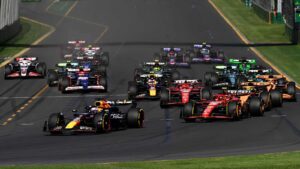
The moment the five red lights went out, the fight was on. From his second-place starting position, Hamilton got a blistering launch, immediately pulling alongside Verstappen as they hurtled towards the first corner. For a few breathtaking seconds, they were perfectly matched, two apex predators refusing to give an inch. Verstappen, on the outside, held his ground with aggressive defending, forcing Hamilton to slot back in behind him. The message was clear: there would be no easy pass.
What followed was less a race and more a 52-second duel. Through every twist and turn of the opening lap, Hamilton’s silver Mercedes was glued to the gearbox of Verstappen’s Red Bull. He would feint to one side, then the other, looking for any sliver of an opening. Verstappen defended masterfully, placing his car exactly where it needed to be to block each attack. For the thousands of fans at Silverstone and millions watching worldwide, this was the essence of wheel-to-wheel racing: a high-speed chess match where a single mistake could end it all.
As they rocketed down the long straight, they approached one of the fastest and most fearsome corners on the entire F1 calendar: Copse Corner. It’s a sweeping right-hand bend that drivers typically take at full throttle, a true test of bravery and commitment. Seeing a small gap on the inside, Hamilton made his move. He pulled his car alongside Verstappen, positioning himself to challenge for the lead in a daring, high-risk maneuver. For a split second, they were side-by-side, hurtling towards the turn-in point at nearly 180 mph (290 kph).
This was the flashpoint. As Verstappen turned in to follow the normal racing path, Hamilton was still there on the inside. His front-left tire made contact with Verstappen’s rear-right. The touch was slight, but at that phenomenal speed, the consequences were enormous. Verstappen’s car was instantly sent into a violent, uncontrollable spin. It sliced sideways across the gravel trap—a safety area designed to slow cars down—and slammed into the tire barrier with terrifying force. In the space of a heartbeat, the championship leader was out of the race, his car a wrecked testament to the brutal physics of motorsport. Hamilton, meanwhile, continued on, his car damaged but still running.
A Tale of Two Fates: The Hospital vs. The Podium
The silence that followed the impact was deafening. Onboard data from Verstappen’s car would later reveal the shocking force of the collision: 51 Gs. To put that in perspective, G-force is a measurement of an object’s acceleration, and a 51G impact is like experiencing 51 times the pull of gravity all at once. Even highly trained fighter pilots struggle to endure a fraction of that force. Though shaken, Verstappen climbed from the wreckage but was immediately taken to a nearby hospital for precautionary checks. His race was over; his health was now the priority.
With a car buried in the tire barrier and debris scattered across the track, race officials had no choice. They deployed the Red Flag, which acts as a universal stop sign for the entire race. This crucial safety measure brings all remaining cars back to the pits and stops all on-track action. It allows emergency crews to safely attend to a driver and clear wreckage without other cars flying past at speed, effectively hitting a giant pause button on the entire event.
For Lewis Hamilton, however, this pause was a lifeline. He nursed his damaged car back to the pits, where the race stoppage gave his mechanics a golden opportunity to make repairs. The contrast in fortunes was brutally stark. As one driver was being helped from his wrecked car, his championship hopes for the day shattered, the other was preparing to rejoin a race that was now wide open. The crash had taken out his biggest rival, and despite the damage, Hamilton still had a chance to win.
What Are the Unwritten Rules of a 180-MPH Duel?
The question that immediately hung over the wreckage was simple: Who was to blame? In high-speed racing, incidents are rarely black and white. Instead, they are judged against a set of principles that govern wheel-to-wheel combat. For the officials watching, and for the millions of fans debating online, the answer depended entirely on how one interpreted the battle for a single piece of asphalt.
The duel hinged on the concept of the racing line—the most efficient path through a corner that allows a driver to carry the most speed. It’s a smooth arc from the outside edge, clipping the innermost point (the apex), and flowing back out. Both Hamilton and Verstappen desperately wanted to be on it.
But what happens when two cars arrive at a corner at the same time? This is where a crucial guideline, often called the “significantly alongside” principle, comes into play. In essence, for the attacking driver on the inside (Hamilton) to earn the right to “own” a piece of the corner, their front wheels must be at least next to the other driver’s cockpit before they both begin to turn. If they are, the driver on the outside (Verstappen) is expected to leave them space. If they are not, the attacker is expected to yield.
This was the heart of the debate. Hamilton believed he was far enough alongside to claim his space. Verstappen, defending his position, turned into the corner as if the racing line was his alone, clearly believing Hamilton had not earned that right. At 180 mph, these two conflicting interpretations resulted in contact. The race officials, known as the stewards, now had the unenviable task of reviewing the footage and making a judgment call that would have massive consequences.
Was the 10-Second Penalty a Slap on the Wrist or a Just Punishment?
After reviewing the incident from every possible angle, the race officials—a panel of expert judges known as the stewards—delivered their verdict. They determined that Hamilton was “predominantly to blame” for the collision but that Verstappen also played a part by not yielding. The ruling wasn’t about malice; it was about a misjudgment at incredible speed. Consequently, Hamilton was handed a 10-second time penalty, a punishment that sounds simple but comes with a crucial catch: it must be served during a pit stop.
In Formula 1, drivers must make at least one pit stop during a race to get a fresh set of tires. This stop is a blur of choreographed chaos, usually lasting just two to three seconds. Hamilton’s penalty meant that when he drove into the pits, his mechanics had to stand perfectly still and wait for a full 10 seconds before they could touch his car. In a sport where races are won and lost by thousandths of a second, this forced delay was designed to be a significant setback, potentially costing him any chance of victory.
The decision immediately split the F1 world, creating two fiercely opposed arguments that are still debated today:
- The Just Punishment View: Supporters of the stewards’ call argued that the penalty fit the crime. Hamilton was found mostly at fault for initiating the contact and deserved to be punished. Ten seconds was a standard penalty for such an incident, acknowledging a mistake without branding him a villain.
- The Slap on the Wrist View: For Verstappen’s Red Bull team and his fans, this was an outrage. Their driver was in the hospital, his car was destroyed, and his championship lead was about to be erased. They argued that a penalty that still allows the offender to win the race is no real penalty at all.
Ultimately, because the race had been temporarily stopped to repair the track barrier after Verstappen’s crash, Hamilton’s team had been given a “free” opportunity to fix his own car’s damage. With a healthy car, the 10-second penalty was the only major hurdle left between him and victory. He served his time, rejoined the track, and began a furious chase to the front. While the debate over the penalty’s fairness raged, Hamilton retook the lead on the final laps to win the British Grand Prix. But it was his passionate celebration in front of his home crowd that truly ignited the war of words to come.
Why Hamilton’s Celebration Sparked So Much Anger
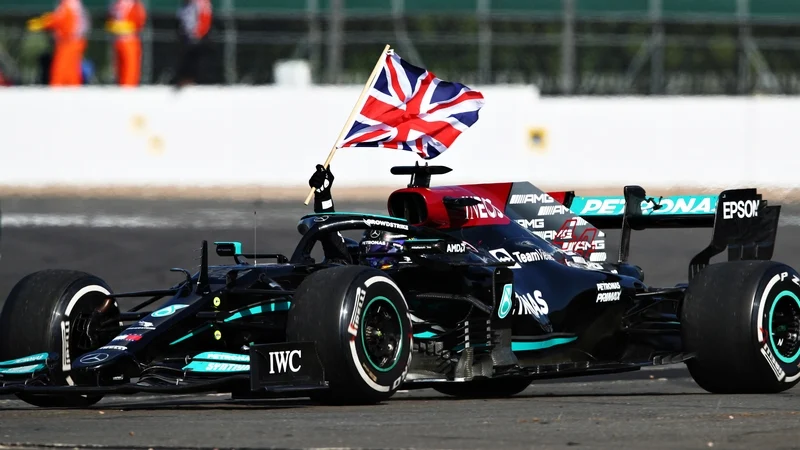
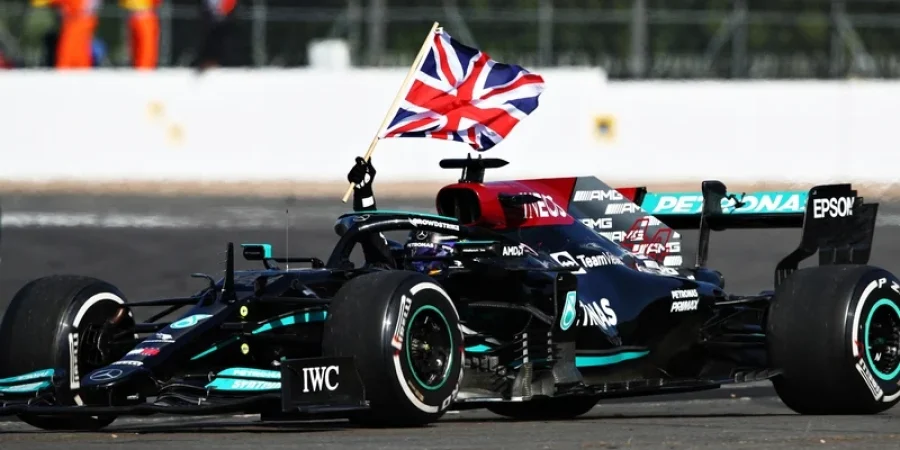
For Lewis Hamilton and the roaring British crowd, the victory was a moment of pure ecstasy. After a difficult season, their hero had overcome a penalty to win on home soil, triumphantly waving the Union Jack as he celebrated a crucial comeback. But miles away from the champagne-soaked podium, a very different scene was unfolding. Max Verstappen was in a local hospital undergoing precautionary checks. It was this stark contrast—one driver celebrating, the other being examined after a crash caused by his rival—that turned a racing incident into a deeply personal and bitter feud.
The fury from the Red Bull team was immediate and unfiltered. Their team boss, Christian Horner, was incensed, calling Hamilton’s move “desperate” and labeling the victory “hollow.” He felt that celebrating so passionately while his rival was hospitalized was a massive breach of conduct in a sport where drivers share immense risks. The feeling was shared by Verstappen himself, who later tweeted from the hospital. While glad he was okay, he criticized the “disrespectful and unsportsmanlike behavior” of the post-race celebrations, making it clear he saw it as a personal slight.
This wasn’t just a case of sour grapes over a lost race. To Red Bull and many onlookers, the issue was one of basic sportsmanship. In their view, a driver shouldn’t celebrate a win that came at the direct expense of a competitor’s health and safety. The Hamilton camp, however, saw it differently: he had served his penalty, won the race fairly under the rules, and had every right to celebrate a monumental home victory. This fundamental disagreement over what was acceptable—the on-track move and the off-track reaction—ensured the conflict wouldn’t end at Silverstone. A rivalry had officially become a war.
The Legacy of a Rivalry Set Ablaze
The collision at Copse corner was an earthquake for the 2021 season. With a single, controversial win, Lewis Hamilton slashed Max Verstappen’s 32-point championship lead down to just 8, reigniting a title fight that had been slipping away. That afternoon at Silverstone became the definitive turning point, transforming the championship from a marathon into a bitter, down-to-the-wire sprint.
The crash did more than just change the points standings; it poisoned the well, turning a competitive rivalry into a hostile feud that defined the rest of the season. The debate over blame, the fairness of the penalty, and the appropriateness of the celebration cemented the lines between two warring camps. What happened at the 2021 British Grand Prix was the exact moment a fierce rivalry caught fire, sparking a grudge match for the ages and cementing its place as one of the most unforgettable flashpoints in modern motorsport history.