
Imagine you are on the verge of achieving your life’s dream. The entire world is watching. For Brazilian driver Ayrton Senna, that moment arrived at the 1988 Japanese Grand Prix. He sat in the best possible starting spot, pole position, needing only a clean getaway to charge toward his first Formula 1 World Championship. As the starting lights went out, his championship rival shot into the lead. But Senna’s car, in a heart-stopping moment of failure, didn’t move. The engine had stalled, and in a deafening roar, the entire field of cars swarmed past him, leaving him stranded as his dream seemingly vanished.
This single moment was the explosive flashpoint in what is widely considered the greatest rivalry in motorsports. The Senna vs Prost rivalry was a clash of titans who were, ironically, teammates. In one corner was Alain Prost, the reigning French champion known as “The Professor” for his cold, calculating precision. In the other was Senna, a deeply spiritual and fiery rookie whose raw, instinctive speed felt like a force of nature. They shared the same McLaren-Honda car, a machine so dominant it won 15 of the 16 races that season, meaning their only true competition was each other.
That day in Japan, the stakes could not have been higher. This was the decisive battle for the World Championship, the ultimate prize in racing. The complex points system boiled down to a brutal, simple truth: for Ayrton Senna to win his first world title, he had to win this race. Period. If Prost finished ahead of him, the championship fight would be dragged to the final round, where the math heavily favored the Frenchman. It was all or nothing, right here, right now.
Sitting motionless on the Suzuka circuit as his rival disappeared into the distance, Senna’s chances looked less than zero. Any normal driver’s race—and championship hopes—would have been over. What followed, however, was not an admission of defeat but the beginning of one of the most legendary comebacks in sports history, a drive that would forever define his legacy and cement his place as a legend.
Why Senna and Prost Weren’t Just Rivals—They Were Polar Opposites in the Same Car
Alain Prost had earned his nickname, “The Professor.” A cool and calculating driver, he treated every race like a chess match, always thinking several moves ahead. His goal wasn’t just to win the battle but the war—the season-long championship. Prost was famous for his smooth, efficient style, never taking a needless risk and driving just fast enough to secure the result he needed. To him, racing was a science of precision and percentage plays.
On the other side of the McLaren garage was Ayrton Senna, a man who drove with raw instinct and fiery passion. Where Prost was a surgeon, Senna was a force of nature. He wasn’t interested in just winning; he was on a spiritual quest to find the absolute limit of his car and himself on every single lap. Senna would push into gaps that seemed impossibly small, relying on unmatched car control and a belief that his talent gave him the right to be there.
Forcing these two polar-opposite philosophies into the same team created one of the most intense situations in sports history. Because their car was so superior to the rest of the field, their only true rival was each other. The 1988 season became a bitter civil war, a clash not just of speed, but of personality and belief. This raises a crucial question: just what made their shared McLaren car so untouchable?
What Made the 1988 McLaren MP4/4 So Untouchable?
The McLaren MP4/4 wasn’t just a good car; it was a phenomenon. To call it dominant is an understatement. In the 1988 Formula 1 season, the team entered 16 races and won an astonishing 15 of them. For every other team on the grid, simply seeing the iconic red and white McLarens in their mirrors was a sign that the fight for first place was already over. This level of superiority is almost unheard of in any top-tier sport.
This created a unique and intensely pressurized situation. With no real threat from other teams, the entire World Championship battle was fought inside the McLaren garage. The season became a private duel between Senna and Prost. Every race weekend, they weren’t just fighting for a win; they were fighting each other for supremacy, using the exact same machinery. It turned the concept of “teammate” on its head, transforming it into “primary competitor.”
The secret to this incredible performance was a perfect marriage of a brilliant car design and a powerhouse engine. That power came from Honda. The Japanese manufacturer supplied McLaren with an engine that was not only immensely powerful but also remarkably reliable. This combination turned the McLaren MP4/4 into an unbeatable weapon, leaving the championship to be decided between its two drivers. And due to a strange quirk in the rules, the stage for their final, decisive battle was set for Japan.
How a Strange Rule Meant Senna Had to Win in Japan—Or Lose Everything
That quirk in the rules came down to a simple but unusual system for deciding the champion. In 1988, a driver didn’t get to keep the points from every race. Instead, only their best 11 results from the 16-race season counted toward their final score. Think of it like a class where the teacher agrees to drop your worst five test scores. This meant that after a certain point, a good result wasn’t good enough; a driver had to score better than one of their existing top-11 finishes just to add to their total.
For Ayrton Senna, this created a dramatic all-or-nothing scenario at the Japanese Grand Prix. He had already won seven times, giving him a strong collection of top scores. Because of this, another second or third-place finish would be useless—he’d have to drop an existing score, and his total wouldn’t change. The math was brutal: to secure the title in Japan, he had to win the race. Anything less, and the championship fight would go to the final race in Australia, where Prost held the advantage.
Alain Prost, however, was in a much more comfortable position. His season had been a model of consistency, with a mix of wins and strong second-place finishes. Unlike Senna, Prost could still improve his championship total by finishing on the podium, even if he didn’t win. He could afford to play a strategic, safer race. Senna could not. With the championship hanging by this single thread, Senna lined up on the grid knowing only victory would do. The pressure was immense.
Disaster on the Grid: What Happened When Senna’s Car Refused to Move?
Having secured the coveted pole position—the number one spot at the very front of the grid, reserved for the weekend’s fastest driver—Ayrton Senna had the perfect view. From there, he had a clear, unobstructed path into the first corner. It was the ideal launchpad for the win-or-nothing race he faced. His greatest rival and teammate, Alain Prost, sat beside him in second, perfectly positioned to capitalize on the slightest mistake.
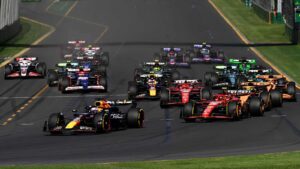
But as the starting lights went out to begin the race, the unthinkable happened. Senna’s McLaren-Honda didn’t launch forward; it barely moved. He had stalled the engine. Just like a normal road car can lurch and die, his highly-strung F1 machine sat motionless. In a terrifying blur of noise and color, the entire field of cars swarmed past him, his championship hopes seemingly evaporating in seconds. From the best seat in the house, he had plummeted to 14th place before he even crossed the starting line.
In that moment of total disaster, a quirk of the Suzuka circuit saved his race. The main straight isn’t perfectly flat; it runs on a gentle downhill slope. Frantically waving his arms to avoid being rear-ended, Senna used the slight incline to let his car roll forward, bump-starting the engine back to life. It was a small miracle that kept him from being eliminated on the spot. His championship dream wasn’t dead, but it was hanging by the thinnest of threads. The chase was on.
The Charge of a Lifetime: How Senna Sliced Through the Field in 8 Laps
With his engine finally roaring, Senna transformed from a stationary target into a relentless predator. What followed was a masterclass in aggressive, inch-perfect driving. He wasn’t just making up places; he was dismantling the competition. On the very first lap, he scythed past an incredible six cars, catapulting himself from 14th place to 8th. Drivers who had blown past him on the grid suddenly found the iconic yellow helmet filling their mirrors, a signal that they were merely obstacles in a much bigger story. The despair of the stall was instantly replaced by the raw thrill of the chase.
This blistering pace continued. By the end of the fourth lap, Senna had climbed to sixth place. This wasn’t just another position; it was a critical milestone. In Formula 1, you only earn championship points by finishing in the top spots, and in 1988 that meant finishing sixth or higher. By re-entering these points-paying positions so quickly, Senna had done more than just recover—he had put himself back in the championship fight. The impossible suddenly seemed plausible again.
The charge was far from over. Driving like a man possessed, he picked off two more rivals, climbing to fourth place by the end of lap eight. In less than fifteen minutes, he had undone the catastrophic damage of his stall, passing ten of the world’s best drivers. He had turned a career-defining disaster into one of the most astonishing recovery drives the sport had ever seen. Now, only three cars remained between him and his rival Prost. The hunt was truly on, but as the sky began to darken, the race was about to change completely.
Why Rain Became Senna’s Greatest Ally at Suzuka
Just as Senna closed in on the leaders, the skies over Suzuka opened up. What started as a light drizzle quickly intensified, transforming the track into a treacherous ribbon of black ice. In motorsport, rain is known as “the great equalizer.” A car’s technological superiority—its powerful engine or sophisticated aerodynamics—means far less when the tires can’t find grip. Suddenly, the race is no longer about who has the best machine, but who has the most skill, bravery, and feel for the slippery surface. The advantage swings from the engineer back to the driver.
For most drivers, rain is a nightmare. For Ayrton Senna, it was an opportunity. He was a master in the wet, a “Rainmaster” whose driving style was almost supernatural in these conditions. Where other drivers relied on calculated data and predictable physics, Senna drove by pure instinct. He could feel the precise moment a tire was about to lose its grip, dancing the car on a razor’s edge that no one else could find. His raw, emotional connection to the car allowed him to thrive in the chaos, turning a treacherous track into his personal playground.
This dramatic shift in weather completely changed the dynamic of the race. Alain Prost, leading comfortably in the dry, was now on the defensive, forced to drive cautiously to avoid a costly mistake. For Senna, the hunter, the rain was a gift. It erased Prost’s remaining advantage and handed Senna the ultimate weapon: a stage where his unique genius could shine brightest. The gap between them began to shrink with every lap as Senna unleashed his full talent. The final showdown for the championship was on.
The Checkmate Move: How a Backmarker Decided the World Championship
By lap 27, the gap had vanished. In the blinding spray, Senna was glued to the back of Prost’s McLaren, a menacing yellow helmet filling the Frenchman’s mirrors. For lap after agonizing lap, the two greatest drivers on earth engaged in a high-speed chess match on a slippery, treacherous board. Prost, the defending champion, drove with calculated precision to protect his lead. Senna, the challenger, probed for any sign of weakness, waiting for the perfect moment to strike. The entire championship now hinged on this single, nerve-shredding duel in the rain.
As if this wasn’t dramatic enough, they soon faced another challenge: traffic. The leaders were now so fast they were lapping the slower cars at the back of the field, known as “backmarkers.” In racing, these slower cars are required to move aside for the leaders, but doing so on a narrow, wet track is unpredictable. For the driver in front, like Prost, a backmarker is a dangerous, moving obstacle that can ruin their rhythm. For the driver hunting them down, like Senna, it represents a golden opportunity.
The moment of truth arrived as they roared onto the main straight to begin lap 28. Prost approached a backmarker to put another lap on him, but the slower car’s uncertain line in the wet forced Prost to lift off the accelerator for a split second. That was all the invitation Senna needed. Showing incredible commitment, Senna kept his foot down, jinked to the inside, and blasted past both the backmarker and his stunned rival in one fluid, breathtaking maneuver. In that single display of audacious bravery, Ayrton Senna seized the lead, and with it, put one hand firmly on the world championship trophy.
Through The Eyes of a Champion: Prost’s Side of the Suzuka Defeat
While Senna’s charge through the field was the stuff of legend, the story from inside the other McLaren was one of quiet frustration. For Alain Prost, watching his rival grow larger in his mirrors wasn’t just about Senna’s brilliant driving in the rain; it was a battle he was fighting against his own machinery. From his perspective, the race wasn’t a simple case of being out-driven, but of being hamstrung at the worst possible moment.
The core of Prost’s trouble was a subtle but critical mechanical issue. His gearbox, the mechanism that lets a driver shift gears to control the car’s speed and power, was beginning to fail. He reported that it was becoming difficult to select certain gears, a massive handicap on a slippery circuit where smooth, precise control is the key to survival. Every gear change became a small gamble. This meant that while Senna could attack with full confidence, Prost was forced to drive defensively, managing a car that was no longer responding perfectly to his commands.
In the end, Prost saw the result as a bitter combination of bad luck and mechanical failure. He had been skillfully managing a compromised car in treacherous conditions, only to have his race line blocked by a slower car at the exact moment his greatest rival was ready to pounce. While he never denied Senna’s incredible talent, Prost left Japan feeling that fate, more than a fair fight, had decided the championship. This sense of injustice would pour gasoline on the fire of their rivalry, setting the stage for even more dramatic confrontations to come.
More Than a Race: Why Suzuka 1988 Cemented the Senna Legend
The 1988 Japanese Grand Prix was more than just another race; it was a high-speed chess match, a clash of titans, and the moment a legend was forged in pouring rain. This single event captured the human drama that defined an era of motorsport, revealing the compelling story behind the speed.
That single afternoon at Suzuka became the perfect summary of Ayrton Senna. The disastrous stall at the start revealed his vulnerability, yet the ferocious comeback that followed showcased his unwavering resilience. When the heavens opened, his transcendent skill in the wet seemed almost supernatural, turning a disadvantage for others into his ultimate weapon. This race was Senna in microcosm: facing down disaster to achieve the impossible.
This victory wasn’t just about points on a leaderboard; it was about conquering “The Professor.” Defeating Alain Prost, the calculated master, in a straight fight was the only way for Senna to truly prove himself. The raw emotion of that day answers the question of why the Senna-Prost rivalry was so intense—it was a deeply personal battle for dominance that would set the stage for their explosive future conflicts. This wasn’t just a win; it was a coronation.
You now hold a deeper appreciation for the Senna mythos. The next time you come across a classic Formula 1 highlight, try watching it with this new lens. Don’t just follow the cars; look for that signature blend of spiritual focus and relentless attack. As you see Ayrton Senna cross the line to claim his first world title, finger pointed to the sky, you will no longer see just a driver winning. You will see a man embracing his destiny, and you will understand why the world could never look away.