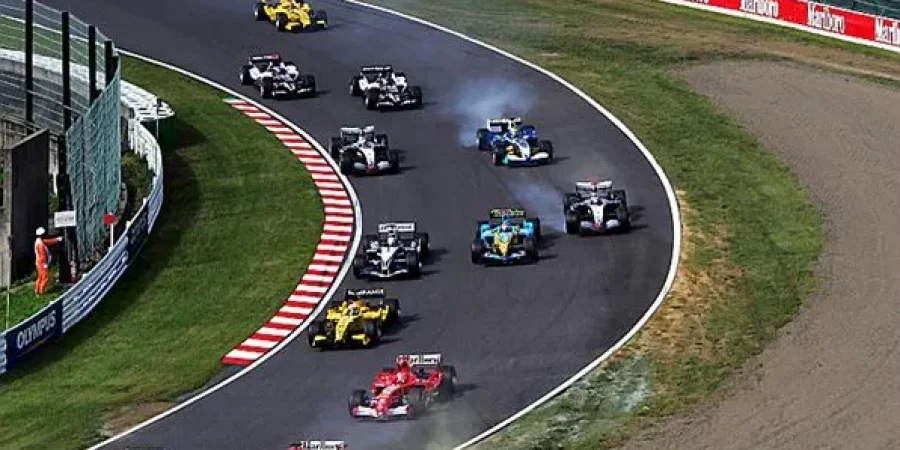

Imagine starting a marathon a full mile behind everyone else. That’s the impossible task Kimi Räikkönen, a driver known as ‘The Iceman’ for his cool demeanor, faced at the 2005 Japanese Grand Prix. A freak rainstorm during qualifying—the high-stakes Saturday session that decides the starting order—left him near the very back of the pack. To win, he’d have to pass almost the entire field of the world’s fastest drivers. What happened next felt less like a sport and more like a Hollywood script.
Every great story needs a compelling cast, and this race had three larger-than-life personalities who would define the event. Besides the silent hero Räikkönen, there was the “Young Champion,” Fernando Alonso, a fiercely aggressive Spaniard who had just ended an era of dominance. And then there was “The Legend” himself, Michael Schumacher, the seven-time world champion and living icon who was not yet ready to give up his throne. This wasn’t just a race; it was a showdown between three of the greatest drivers to ever grip a steering wheel.
So, why is the 2005 Japanese Grand Prix famous nearly two decades later? Because on a legendary figure-eight racetrack in Japan, these three characters delivered a real-life blockbuster. The Suzuka circuit, known for rewarding bravery and punishing the slightest mistake, became the perfect arena for their clash. Powered by screaming V10 engines that sounded like nothing on earth, their duels created one of the most spectacular “passing of the torch” moments ever seen, with overtakes so daring they are still studied by fans in disbelief.
This is the story of that day. It’s not about complex engineering or obscure rules. It’s a narrative of an incredible comeback, a clash of titans, and a breathtaking fight to the finish line that culminated in one of the greatest overtakes in motorsport history. Forget what you think you know about car racing; you’re about to witness a drama so perfect, it feels like it was written for the big screen.
The Perfect Storm: How a Sudden Downpour Created an Impossible Starting Lineup
Every car race has a starting line, but in Formula 1, where you stand on that line can decide everything. That order isn’t random; it’s earned in a high-pressure session called qualifying. This is essentially a one-lap sprint against the clock where each driver, alone on the track, tries to set the absolute fastest time. The quickest driver gets to start in first place, a massive advantage that gives them a clear road ahead. A poor result, however, can leave even the best driver buried deep in the field, with a mountain to climb before the race has even begun.
Just as the championship’s top drivers were set for their qualifying laps in Japan, the heavens opened. A freak downpour drenched the Suzuka circuit, turning the session into a lottery. Race cars are incredibly sensitive to weather. On a dry track, they use smooth “slick” tires that act like ultra-sticky glue, gripping the road with immense force. In the rain, however, those slicks are useless—like trying to sprint on an ice rink in dress shoes. The few drivers who ran their laps in the dry posted fast times. But the sport’s biggest stars, who went out last, had to skate around a treacherous, flooded track.
The result was a starting grid that looked completely upside down. Underdog drivers from mid-field teams found themselves at the front. And the titans of the sport? The newly crowned world champion, Fernando Alonso, was stranded in 16th place. His rival, Kimi Räikkönen, was even worse off in 17th. In a sport where passing just one car is a monumental challenge, they were starting in another time zone. Winning from that far back wasn’t just unlikely; it was considered impossible, setting the stage for one of the most chaotic and thrilling races in history.
Act One: How to Survive the Most Dangerous 60 Seconds in Motorsport
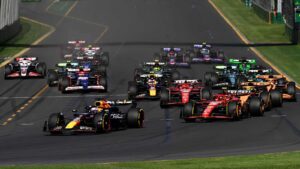
The start of a Formula 1 race is unlike anything else in sports. It’s not a staggered release; it’s a simultaneous explosion. When the five red lights go out, twenty of the most powerful cars on the planet launch toward the first corner at the same time. This initial 60-second scramble is pure, distilled chaos—a breathtaking and terrifying dance where a race can be won or, more often, lost in a single blink. It’s the moment of maximum risk, where millions of dollars in engineering and a driver’s championship hopes can be shattered in an instant.
For drivers buried deep in the field, like Räikkönen and Alonso, this chaos is amplified tenfold. Starting in the middle of the pack is like being caught in the center of a stampede. Visibility is choked by the spray and exhaust of cars ahead, and there’s nowhere to escape. A single mistake from another driver can trigger a chain reaction, collecting innocent victims who had no way to react. Surviving the opening lap from 17th on the grid isn’t about attacking; for most, it’s simply about getting through without being taken out.
But where others saw danger, Kimi Räikkönen saw opportunity. As the lights went out, “The Iceman” was anything but cool. He was ferocious. While his rivals gingerly navigated the crush of cars, Kimi drove with calculated aggression, darting his McLaren into gaps that seemed to exist for only a fraction of a second. He went around the outside of some, dived down the inside of others, and used every inch of the racetrack. By the time the cars crossed the finish line to complete the very first lap, Räikkönen had miraculously climbed from 17th to 12th place.
That stunning first lap was a declaration of intent. He had survived the most dangerous part of his race and gained a remarkable five positions in the process. But the sprint was over. Now, the marathon began. Raw speed and bravery alone wouldn’t be enough to win; the fight would now shift from the visceral chaos of the track to the unseen chess match playing out on the pit wall.
The Unseen Chess Match: Why F1 Is More Than Just Driving Fast
While Kimi was fighting car-to-car, his team was playing an entirely different game—one of numbers and timing. In Formula 1, being the fastest driver isn’t always enough. Winning requires a perfect strategy, and the most crucial decision revolves around something we can all understand: fuel. It’s a simple trade-off. The less fuel a car carries, the lighter and faster it is. The catch? A lighter car has to stop more often, and every stop costs precious time.
These stops are called pit stops, and they are marvels of human choreography. A driver pulls into a designated box, and in a blur of motion, a crew of nearly twenty mechanics swarms the car. They refuel it with a high-speed hose, swap all four tires, and send the driver back into the race in under ten seconds. For the audience, it’s a flash of organized chaos. For the team, it’s the moment their strategic gamble is placed on the table.
This is where the chess match truly begins. Do you give your driver a light car for a short, fast sprint, knowing they’ll need to stop early? Or do you fill the tank, weighing the car down but allowing the driver to stay on the track much longer than anyone else? This decision was central to the race, dictating the rhythm of the entire event during an era of in-race refueling.
As the race unfolded, this long-game strategy became Räikkönen’s secret weapon. While his direct rivals pitted for a quick “splash-and-dash” of fuel, Kimi’s team loaded his car for a much longer run. He would emerge from his pit stop behind them, but his race was far from over. One by one, his competitors had to peel off into the pits for a second time, helpless to defend as Räikkönen swept past their empty track space. This clever plan was the key to his comeback, clearing the way for him to hunt down the giants of the sport. Now, only two legends stood in his way.
The Lion vs. The Legend: Why One Overtake Signaled the End of an Era
While Kimi Räikkönen was closing in from behind, a different battle for the ages was brewing further up the road. It pitted the undisputed king, Michael Schumacher, in his iconic red Ferrari, against the man who had just taken his crown as the new world champion, the young and aggressive Fernando Alonso. It was the legend versus the heir apparent, a duel that would be decided on one of the most feared pieces of asphalt in the world.
Most racetracks have slow, tight corners that are natural places for overtaking. Suzuka has the opposite: a corner named 130R. It’s not so much a turn as a terrifyingly fast, sweeping left-hand bend taken at over 180 miles per hour. For drivers, it’s a gut-check, a test of pure courage where the immense forces acting on the car and body punish the slightest hesitation. It is a place where you survive, you don’t attack—or so everyone thought.
Chasing Schumacher down the long back straight, Alonso saw his chance as they screamed towards 130R. In a move of breathtaking audacity, he refused to lift his foot from the accelerator. He swung his car to the outside of the track, a line considered suicidal by most, and stormed past the seven-time world champion as if he wasn’t there. The overtake was a moment of pure, unblinking commitment that left commentators and fans speechless.
This was more than just a pass for position; it was a statement. By conquering the sport’s greatest icon on a corner that demands total respect, Alonso proved that the guard had officially changed. It remains one of the most defining “passing of the torch” moments and one of the best overtakes in F1 history. But while the world was still reeling from this symbolic duel, another driver was quietly focused on the ultimate prize. With that battle resolved, The Iceman had just one car left to hunt down.
The Iceman’s Hunt: How Relentless Attacks Put Räikkönen in Striking Distance
While the champions battled for pride, Kimi Räikkönen was fighting for the win. Getting past another Formula 1 car isn’t just about flooring the accelerator; it’s a high-speed chess match called “race craft.” A driver can’t simply drive through an opponent. Instead, they must apply relentless pressure, forcing the driver ahead into a tiny mistake—braking a fraction too late, turning a bit too wide—and then pouncing on that momentary weakness. It’s an art form requiring patience, precision, and a killer instinct. For nearly an hour, Räikkönen put on a masterclass.
Armed with a car, the McLaren MP4-20, that was famously fast but fragile, Kimi attacked the field with surgical aggression. Lap after lap, he would stalk his next target, using his car’s superior speed on the straights to draw alongside before diving into a corner with breathtaking commitment. He wasn’t making wild lunges; he was executing a plan. Each overtake was a calculated move, one piece of a giant puzzle that was taking him from 17th place all the way to the front. He dispatched former champions and seasoned veterans with the same icy calm, his progress looking less like a possibility and more like an inevitability.
This relentless climb is why fans still speak of this race in hushed tones. It’s exceedingly rare for a driver to move through more than a few cars, let alone the entire field. By the time the race entered its final stages, Räikkönen had sliced his way past fifteen other drivers, completing one of the greatest drives from the back of the grid ever witnessed. The impossible part of his job was already done. He had survived the midfield chaos and out-maneuvered his rivals.
Now, only one car remained. Far up the road, Giancarlo Fisichella was leading the race, seemingly on his way to a comfortable victory. But in his mirrors, a silver and black dot was growing larger with every passing second. The gap, which had once been a chasm, was shrinking to a crack. The hunter had his final target in sight, setting the stage for one of the most dramatic final laps in sports history.
The Final Lap: How Kimi Stole an “Impossible” Win at the Last Second
As the final lap began, the entire Suzuka circuit held its breath. For 52 laps, Giancarlo Fisichella had driven a masterful race, keeping his Renault at the front and managing the gap to his pursuers. Now, that gap was gone. In his mirrors, the silver McLaren of Kimi Räikkönen was a predator filling the frame, just a few car lengths behind. After an hour and a half of racing, it had all come down to one last trip around the track, a final 3.6-mile sprint to decide the winner.
To pull off this last-second move, Räikkönen had to use a trick that is racing’s equivalent of a slingshot: the slipstream. Imagine trying to run against a strong headwind. Now, imagine running directly behind someone else. You’re shielded from the wind, and it suddenly feels much easier. This is exactly what happens with race cars. The car in front punches a hole through the air, creating a pocket of lower resistance behind it. By tucking into this pocket, or “draft,” a pursuing driver can gain a significant speed boost without any extra power.
Räikkönen executed the plan to perfection. Through the final, terrifyingly fast sequence of corners, he glued his car to the back of Fisichella’s, staying deep in the slipstream. This allowed him to arrive onto the main straightaway with a huge speed advantage. The sound of his V10 engine screamed higher as he rocketed out of the final corner, closing the tiny gap in an instant. The hunter was about to make his move.
For Giancarlo Fisichella, it was the definition of heartbreak. He had done everything right, controlling the race from the front for almost the entire distance. Yet, there was little he could do. He defended the inside line, forcing Kimi to take the long way around, but the slingshot effect was just too powerful. The final lap battle became a cruel lesson in physics; Fisichella was a sitting duck, watching helplessly as the silver arrow in his mirrors grew larger and pulled alongside.
In a breathtaking display of nerve, Räikkönen swung his car to the outside as the finish line rushed toward them. For a few heart-stopping seconds, they were wheel-to-wheel at nearly 200 miles per hour. Then, with the checkered flag in sight, the McLaren’s momentum carried it past the Renault. Kimi Räikkönen crossed the line less than two seconds ahead, completing a victory that commentators and fans alike had deemed impossible. He had started 17th and won on the very last lap, cementing a drive that was more than just a win—it was the creation of a legend.
The Legend It Created: Why Suzuka 2005 Is Your Perfect Gateway to F1
The 2005 Japanese Grand Prix wasn’t just another race; it was a perfect storm of drama, a blockbuster movie brought to life. A freak qualifying session set an impossible stage. A symbolic “passing of the torch” moment between Alonso and Schumacher signaled a new era. And a breathtaking last-lap victory transformed Kimi Räikkönen’s 17th-place start into a legend. This is why the 2005 Japanese Grand Prix is so famous.
To see the legend for yourself, search YouTube for “Japanese GP highlights” or “Kimi final lap 2005.” When you watch, you won’t just see cars—you’ll see the story unfold. You’ll hear the commentators’ disbelief and feel the tension of that final chase, understanding why it’s considered one of the best overtakes in F1 history.
Greatness in sport often leaves clues, and Suzuka 2005 had them all:
- An “impossible” setup: A champion starting from the back against unbeatable odds.
- A “passing of the torch” moment: A rising star challenging an established legend in a wheel-to-wheel duel.
- A dramatic, last-minute climax: A victory seized in the final moments when all seemed lost.
These are the elements that elevate a sport from a competition into a saga. The race at Suzuka wasn’t just a race—it was a testament to human determination, strategy, and the kind of comeback that belongs on the big screen.