
Imagine the final game of a championship series. Two rivals, one trophy. Now, imagine it all comes down to one last, chaotic race where everything that could go wrong, does. This was the 2012 Brazilian Grand Prix, the day Formula 1 delivered a Hollywood blockbuster.
On one side stood Sebastian Vettel, a young German phenom on the verge of a historic third straight title. His challenger was Fernando Alonso, a Spanish warrior widely seen as the best driver of his generation, who had dragged an underdog Ferrari to the brink of glory. Arriving at the season finale, a handful of points was all that separated them; only one would leave a champion.
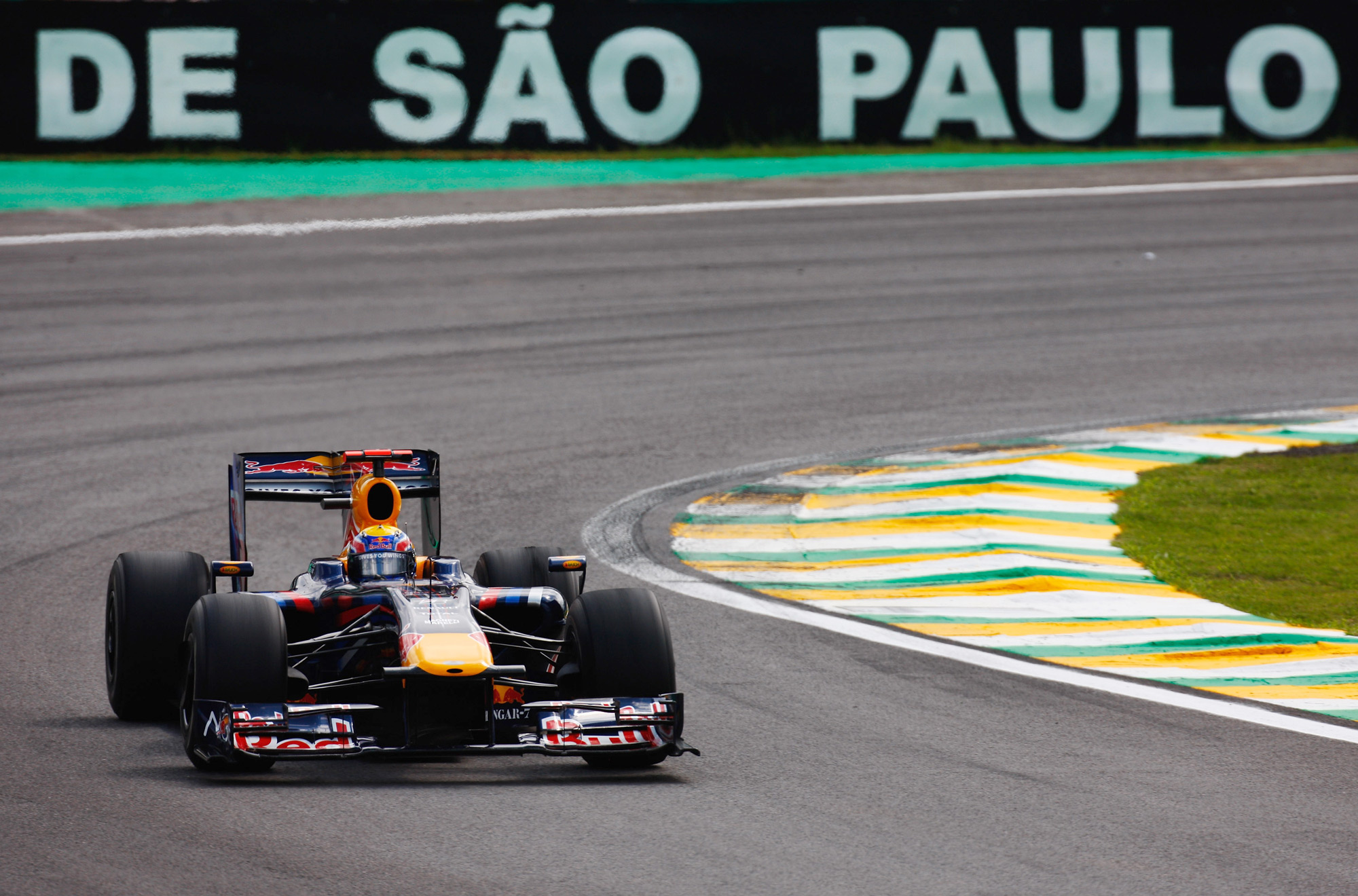
The stage for this final battle was São Paulo’s Interlagos circuit, a track notorious for sudden, torrential downpours that can turn a race on its head. Before the drivers could even complete a single lap, disaster struck the favorite. Vettel’s car was hit, spinning him around to face the wrong way as the entire field swarmed past. He was left damaged, vulnerable, and in last place.
What followed was a 71-lap story of survival and desperate strategy. It was a perfect storm of skill, luck, and shifting weather that cemented the 2012 Brazilian Grand Prix’s legacy as one of the greatest F1 championship deciders of the modern era.
The Prodigy vs. The Gladiator: Meet the Two Rivals Fighting for F1 Glory
The 2012 championship fight had boiled down to two colossal talents, each representing a different path to greatness. This wasn’t just a race between two men; it was a clash of styles, machinery, and legacy, with the world title as the ultimate prize. The entire season had been a tense, back-and-forth duel, setting the stage for one of the most dramatic final-day showdowns in sports history.
In one corner was Sebastian Vettel. Driving for the dominant Red Bull team, the young German was a prodigy on the verge of a dynasty. He was behind the wheel of a car that was clearly the class of the field—faster, more agile, and the envy of every other team. Vettel was the overwhelming favorite, needing only a decent result to secure his third consecutive world championship, a feat only achieved by legends of the sport.
His rival, Fernando Alonso, was a different kind of force. Widely regarded by his peers as the most complete driver on the grid, the Spanish gladiator was fighting with a far blunter weapon. His Ferrari was simply not as fast as Vettel’s Red Bull. Yet, through sheer grit, relentless consistency, and brilliant race craft, Alonso had dragged his underdog car into a title fight it had no business being in. He was the immovable object to Vettel’s unstoppable force.
Arriving in Brazil for the final race, the gap between them was just 13 points. It was a margin so slim that the championship pendulum could swing wildly with every single overtake. For Alonso to win, he needed to finish on the podium and hope for Vettel to stumble. For Vettel, the mission was simple: keep the charging Alonso in his rearview mirror. But in Formula 1, and especially in Brazil, nothing is ever simple.
Disaster on Lap One: How Vettel’s Championship Nearly Ended in 45 Seconds
As the starting lights went out, 24 cars surged into the first corner in a chaotic swarm of noise and ambition. For Sebastian Vettel, the championship favorite, the plan was to have a clean, safe start. But in the tight midfield pack, that plan disintegrated in less than a minute. In the crucial fourth corner, another car made contact with Vettel’s Red Bull, sending him into a helpless spin. His championship hopes pirouetted with him.
Suddenly, Vettel was facing the wrong way, watching the entire field of cars scream past him like a river flowing around a rock. For a terrifying moment, it seemed certain another car would slam into him, ending his race and his title defense on the spot. Miraculously, everyone missed him. But the damage was done. By the time he got his car pointed in the right direction, the pack was gone. The man who started the day on the verge of glory was now in dead last place.
Worse still was the frantic message from his team over the radio. The collision had punched a hole in the side of his car, damaging the fragile floor that gives it speed and stability. Not only was he at the back, but he was driving a wounded machine. On the pit wall, his rival Fernando Alonso’s Ferrari team could taste victory. With Vettel so far back, the championship was now Alonso’s to lose. The near-certainty of a Vettel title had evaporated in just a few heart-stopping seconds.
With his car compromised and his rival cruising near the front, Vettel faced a monumental task. He had to complete 70 more laps—or trips around the 2.6-mile circuit—and somehow fight his way through the entire field. It was an almost impossible challenge, demanding a perfect recovery drive. And just as he began his desperate climb, the sky began to cry.
When The Heavens Opened: Why Rain is Formula 1’s Great Equalizer
For most sports, rain is an inconvenience. For Formula 1, it’s a game-changer that throws every plan out the window. The reason comes down to one thing: tires. F1 cars are built to be so fast and precise that their performance is balanced on a knife’s edge, and the single biggest factor in that balance is the rubber connecting the car to the road.
In dry conditions, cars use tires called “slicks,” which are completely smooth. Think of them like the ultimate running shoes for a dry track, providing the maximum possible grip. But introduce even a little bit of water, and that grip vanishes. Driving on slick tires in the rain is like trying to sprint across a sheet of ice, with every corner threatening to send the car into a spin.
To combat the rain, teams have other options. “Intermediate” tires have shallow grooves to clear away light water, and full “Wet” tires have deep channels for heavy downpours, much like the difference between everyday sneakers and heavy-duty rain boots. But there’s a catch: you can’t change tires on the move. A driver must make a pit stop—a high-stakes, frantic halt where a crew of nearly 20 people swarm the car to change all four tires in under three seconds. While breathtakingly fast, the entire process costs about 25 seconds of race time, a lifetime in F1.
This creates a monumental strategic gamble. Do you pit for rain tires and sacrifice track position, or do you stay out on the faster slicks and risk a crash? Guess right, and you look like a genius. Guess wrong, and your race is over. Such high-stakes decisions are why rain is called the “great equalizer.” It neutralizes the pure speed advantage of the fastest car and puts a premium on driver skill and nerve. As the drizzle intensified over Brazil, the championship was no longer just a race—it was a high-speed chess match against the weather.
The Virtual Championship: How the Title Swung Between Rivals with Every Overtake
To grasp the tension of the 2012 Brazilian Grand Prix, one only needs the concept of the “virtual champion”—the answer to the question: if the race ended right now, who would have the title? For 71 laps, the answer changed constantly, creating a level of tension rarely seen in any sport. The championship wasn’t just a trophy to be won at the end; it was a phantom crown being passed back and forth with every turn of the wheel.
In the instant after Sebastian Vettel’s car spun to a stop on the opening lap, the situation was brutally clear. With Vettel dead last, Fernando Alonso was the virtual champion. The title that had seemed to be slipping away was suddenly in his grasp. For a few brief, electrifying moments, the championship pendulum had swung decisively in Ferrari’s favor.
But Vettel, his car battered but not broken, began a furious climb back through the field. This wasn’t just a driver trying to score a few points; it was a desperate battle for survival. Each car he overtook was another step back towards the title. As he sliced his way from 22nd into the top ten, the math began to shift. With every position he gained, the virtual crown wobbled, threatening to fall from Alonso’s head and back onto his own.
This constant back-and-forth was made even more chaotic by the rain and the pit stops. When a driver would dive in for new tires, they’d temporarily lose several positions, instantly changing the championship picture. One moment, a perfectly timed stop by Alonso would make him the virtual champion. A few laps later, a bold move by Vettel to stay out on a drying track would swing the advantage right back to him. The two teams were in a frantic state, running non-stop calculations, their driver’s fate changing with every radio call.
For the two men inside the cars, the pressure was immense. They were being fed constant updates over the radio—”You need one more position,” “Alonso is now in P3″—while battling slick corners and aggressive opponents. Their fight for the championship wasn’t happening in a vacuum. The track was filled with 22 other drivers, each with their own race to run, and many of them would play an unintentional but decisive role in the final outcome.
More Than a Two-Horse Race: The Wild Subplots That Added to the Chaos
While the championship drama captivated millions, the race wasn’t just a two-man show. For many other drivers, the 2012 Brazilian GP was a day of personal triumph, heartbreak, and pure absurdity, with their stories weaving into the main event and amplifying the chaos.
Perhaps the most stunning subplot was the rise of Nico Hulkenberg. Driving for the smaller Force India team, Hulkenberg wasn’t supposed to be anywhere near the front. Yet, in the slippery, unpredictable conditions, he was masterful. While the champions struggled, he navigated the rain with incredible skill, not only keeping pace but storming into a shocking and well-deserved lead. For a glorious portion of the race, the ultimate underdog was leading the most important event of the year, on the verge of a fairytale victory.
But in a race defined by sudden twists, his dream ended in tears. As the track conditions shifted, he lost control for a split second and collided with Lewis Hamilton, another front-runner. The incident ruined both their races and ended any hope of Hulkenberg’s miracle win. It was a brutal reminder of how quickly fortunes could change.
Even more bizarre was the adventure of Kimi Raikkonen. A former champion known for his cool, unflappable demeanor, Raikkonen slid off the wet track and into an old, paved access road. Rather than reversing, he calmly drove down it, assuming it would lead him back onto the circuit as it had in years past. He was met instead with a surprise: a closed, solid blue gate. The image of his high-tech Lotus F1 car stopped dead at a dead end, forcing him to perform a clumsy U-turn, became one of the most memorable and comical moments of the F1 season.
From Hulkenberg’s heroic charge to Raikkonen’s bizarre excursion, every driver on the grid was battling their own chaotic race. They weren’t just background characters in Vettel and Alonso’s story; they were active participants whose actions—intentional or not—sent shockwaves through the championship fight. And among them was one of the sport’s greatest icons, taking part in his final race, who would have one last, decisive part to play.
A Legend’s Final Bow: How Michael Schumacher’s Last Race Played a Key Role
Amidst the chaos of flying spray and spinning cars, another profound story was reaching its conclusion. This was the last-ever race for Michael Schumacher. For anyone unfamiliar with Formula 1, think of him as the sport’s Michael Jordan or Tom Brady—a seven-time world champion and a living legend whose dominance defined an entire era. His return to racing hadn’t been a fairytale, but his final drive would prove to be quietly pivotal.
As a battered Sebastian Vettel fought his way back through the field after his disastrous first-lap spin, he needed every single position to keep his championship hopes alive. Each car he passed was a small victory, but one particular car ahead of him was different. It was the Mercedes of his childhood hero, Michael Schumacher.
But the battle never came. In what became one of the most poignant moments of the race, Schumacher saw the young German approaching and simply moved aside, offering no resistance. It was a small but hugely significant act. Rather than fight a driver who had everything to lose, the old master gave a clear path to the young champion trying to follow in his footsteps. It was an unspoken acknowledgement of respect and a symbolic passing of the torch.
That single, uncontested pass gifted Vettel a crucial position, edging him closer to the points he desperately needed to clinch the title. It directly influenced who won the F1 championship in 2012. Vettel still had to survive the final, agonizing laps, but with the quiet blessing of a king, his impossible comeback suddenly felt destined.
Victory From the Jaws of Defeat: How a Broken Radio and a Battered Car Secured the Title
As the rain intensified in the race’s final stages, the drama reached its peak. Sebastian Vettel’s car was not only damaged, but his radio had been broken since the first-lap collision. He was driving blind, unable to speak with his team. As other drivers dove into the pits for rain tires, Vettel’s Red Bull crew had to resort to old-school methods, frantically holding up a pit board to scream instructions at him as he flew past at 180 mph.
Just as Vettel was clinging to a sixth-place finish—the exact position he needed to win—disaster struck elsewhere on the track. Another driver crashed heavily, scattering debris across the slippery asphalt. To ensure the drivers could navigate the wreckage safely, officials deployed the “Safety Car.” This special car enters the track and leads the field at a reduced speed, and crucially, no one is allowed to overtake.
The appearance of the Safety Car was the final, decisive twist. With only a couple of laps remaining, there wasn’t enough time to clear the crashed car. The race would finish under these controlled, neutralized conditions. The frantic battle was over; the positions were locked in. Fernando Alonso, who had driven a masterful race to finish in second place, could only watch helplessly as his rival circulated slowly behind the Safety Car, safe in the position he needed.
When the cars finally crossed the finish line in a quiet procession, the math was painfully close. Vettel’s sixth-place finish gave him just enough points to beat Alonso to the 2012 World Championship by a mere three points—one of the narrowest margins in the sport’s history. After 20 races across the globe, a season of epic swings came down to a single pass and a moment of sportsmanship.
On the podium, the contrast was unforgettable. A jubilant Vettel celebrated his third consecutive title, a feat only achieved by legends. A few feet away stood Alonso, his expression a mixture of exhaustion and heartbreak. He had done everything he could, only to lose the crown by the thinnest of threads. It was a perfect, poignant image that captured the brutal beauty of Formula 1: for every incredible victory, there is an equally devastating defeat.
More Than a Trophy: The Legacy of a Modern Classic
The 2012 Brazilian Grand Prix was far more than a simple contest of speed; it was a high-stakes drama played out at 200 miles per hour, where every lap wrote a new story. What made that day so exciting wasn’t just one thing—it was everything, all at once. It was Sebastian Vettel’s impossible comeback from last place, a masterclass in resilience. It was Fernando Alonso’s heroic effort to drag an underdog car to the brink of glory, showcasing pure, unyielding skill.
Woven through it all were the unpredictable threads of luck, as rain turned every decision into a gamble, and the poignant sportsmanship of a legend like Michael Schumacher ceding the track in his final race. This combination of human drama, strategic chaos, and relentless pressure explains why the race is remembered as one of the greatest F1 championship deciders.
It stands as a perfect example of the magic inherent in motorsport: a reminder that behind the technology and speed, the most compelling stories are about resilience, rivalry, and the fight for victory against impossible odds.